The Physics of the Coin Cradle
27 September 2026 · about 10 minutes
The Coin Cradle is a pendulum with a strong magnet at the bottom of its swing. A metal coin under the magnet brakes it, and a ratchet dial adds up how far it travels before it stops. This note explains the reading from first principles: the magnet, the currents induced in the coin, the pendulum's motion, and how the dial counts. Every input is a measured dimension or a handbook value. Nothing is fitted.
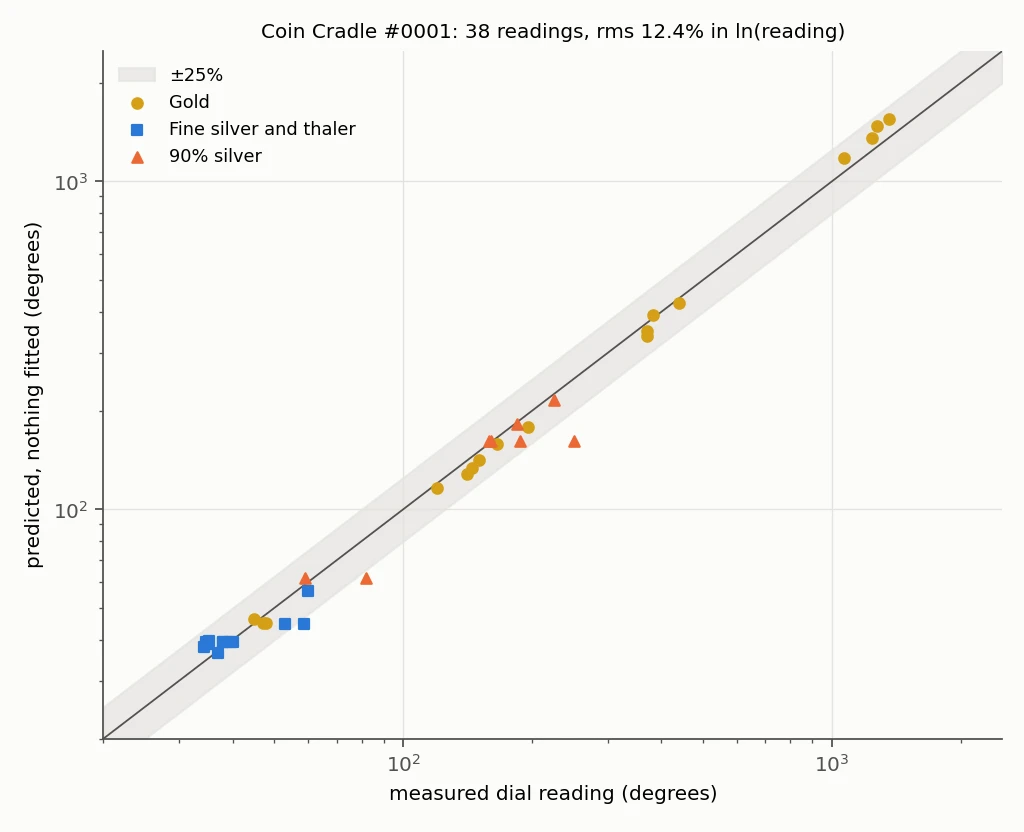
- With nothing fitted, the model predicts the 38 readings on Cradle #0001 to 12.4% rms, with a mean bias of −2.4%. 97% of readings fall within ±25%.
- The error is uneven: 7.9% on gold coins, 11.9% on fine silver, 19.4% on 90% silver coins.
- What it says about fakes is modelled, not measured: no counterfeit has yet been tested on the device.
The instrument
The magnet is an N52 neodymium ring, 23.4 mm across and 20 mm tall, with a 6.1 mm bore, magnetised along its axis. It weighs 60.4 g. Its remanence, the strength of the magnetised material, is 1.42–1.47 T for the N52 grade.
The pivot is fixed 142 mm above the deck. The magnet height is set with spacers that work as 3 mm gauge blocks: they set the magnet face 3S mm above the deck for S spacers, and are removed before the test. The coin lies on the deck, so for a coin of thickness t the gap between the magnet face and the coin is
The pendulum is released from 50°. The coin rests on its rims, so the model places its metal as a slab of effective thickness t_{\text{eff}} = m / (\rho \pi R^2) centred at half the rim height.
What moves
The moving parts are the magnet, a 48.2 g rod, a 32.7 g cross axle and a 4.27 g side screw. Their moment of inertia about the pivot is 1.238, 1.180 and 1.124 × 10⁻³ kg·m² at one, two and three spacers. The magnet contributes 82% of it, the rod 18%, and the axle and screw 0.1% together. The pivot-to-magnet-centre distance is 142 − 3S − 10 mm: 129, 126 and 123 mm.
Changing the rod's inertia by ±15% moves every predicted reading by only ±1.4%, so the drawings of the rod matter little.
Eddy-current braking
As the magnet passes over the coin, the changing field drives loops of current in the metal. Those currents make their own field, which opposes the motion and turns the pendulum's energy into a little heat in the coin.
The field. An axially magnetised ring is equivalent to magnetic charge on its two flat faces. On the axis, at a depth h below the near face, the field has a closed form (outer radius Ro, inner radius Ri, height H):
At Br = 1.445 T this gives 0.255 T at 3 mm and 0.176 T at 10 mm. Everywhere else the model uses the exact closed-form field of the ring (Derby & Olbert, 2010), which agrees with this on the axis to 10−13. Because of the bore, the field falls again very close to the face (0.08 T at 1 mm).
The drag. The magnet does not slide over the coin: it swings on the rod, so it rises as it moves out and it tilts. The model follows that exact motion. At each point of the coin it takes the vertical field of the tilted magnet, \hat B_z(x,y;\theta) for unit remanence, and how fast that field changes with the pendulum angle. The braking torque per unit angular speed is
Here σ is the coin's electrical conductivity, ψ is a stream function for the currents in each thin layer k of the coin, and the weights wk add up to its thickness. A small extra term covers currents that loop through the thickness (0.6–1.7%). The braking is exactly proportional to σ and has no free scale.
Following the real motion matters. A magnet sliding horizontally at the speed of its face would be braked 17–25% less, and would over-predict the readings by about 16% on average.
Why a thin-disc model is valid. The magnet crosses the coin at about 1 m/s. The characteristic speed of the sheet, w = 2/(\mu_0 \sigma t), is at least nine times that for every coin tested, so the currents barely distort the field (a correction of at most 0.9%). The coins are at most a fifth of the skin depth thick, so the test reads the coin's whole thickness, not only its surface.
Edge currents. The currents cannot cross the coin's edge (the ψ = 0 condition). A uniform field drives no current; only the change in field across the coin does. So a small coin sitting under the flat centre of a large magnet is braked far less than a simple “infinite sheet” rule predicts.
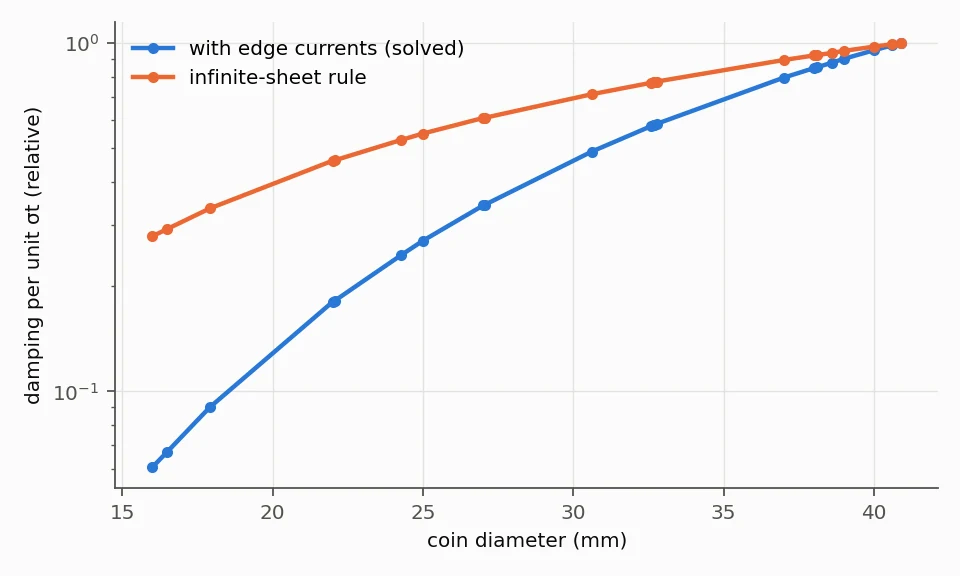
The energy method
The pendulum obeys
where D(θ) is the braking of equation (3) and τf is pivot friction. The magnet lifts off the coin as it swings out; that arc is set by the geometry, not fitted.
The release puts in a fixed amount of energy:
Each pass over the coin removes part of it. The braking is small beside gravity, so the swing dies away over several passes, and the total travel is set by the ratio of the release energy to the energy lost per pass. That is why the reading falls almost exactly as one over the coin's conductivity. The model integrates equation (4) numerically from 50°; halving the time step changes no reading by more than 0.23%.
Friction. Released with no coin, the pendulum is reported to keep swinging for about 4.5 minutes, some 790 half-swings. That puts the pivot friction at no more than about 5.7 × 10⁻⁵ N·m. The figure rests on a recollection, not a recorded measurement, so the model leaves friction out and carries it as an uncertainty.
The ratchet dial
The dial is marked “turn clockwise only” and records cumulative degrees, including full turns, so it is ratcheted, and it advances only on the outward swing. Which outward swings it counts is inferred from the readings. Each rule below has a one-to-one drive and nothing fitted:
| Dial counts | rms error, 38 readings | Mean bias |
|---|---|---|
| Outward strokes on the far side only | 0.124 | −0.02 |
| Outward strokes on the release side only | 0.50 | −0.40 |
| All travel in the return direction | 0.53 | predicts 1.7× too high |
The data pick the first rule: the dial advances only while the pendulum swings outward on the side away from the release. Counting outward swings on both sides would read about 1.6 times too high. The choice is made with the data, so it is not an independent test, but it is not a close one.
Results
The model predicts 38 of the 44 readings in the Cradle #0001 workbook (the other six are clad coins with no listed conductivity).
- Nothing fitted: 12.4% rms in the log of the reading, with a mean bias of −2.4%. 97% of readings fall within ±25%, and 66% within ±10%.
- The level is right. Fitting one overall scale factor does not help when whole coins are held out (12.5%).
- The error is uneven. Gold coins 7.9%, fine silver 11.9%, 90% silver coins 19.4%. The 90% silver coins are also the ones whose dimensions come from catalogue figures rather than measurement, so the geometry is the first thing to check. One reading, a Walking Liberty half dollar at 250 against 161 predicted, contributes a third of the total squared error; it is kept in every figure.
- Uncertainty. The release angle matters most: ±2° moves every reading by ±7%. The clearance under the magnet comes next: ±0.1 mm moves readings by ±3%. All the inputs together, with assumed spreads, account for about 5% per reading. The rest of the 12% is measurement noise, geometry or model error, which repeated releases of one coin would separate.
Telling fakes apart (modelled)
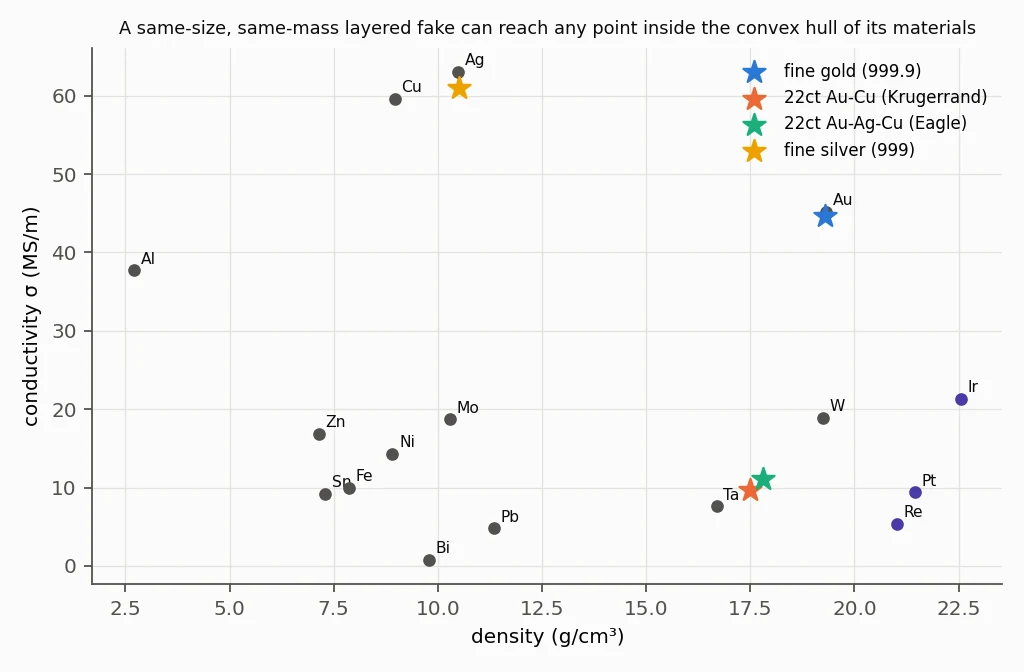
For a fake of the same size, the reading depends on the conductivity times thickness of each layer, weighted by depth. A counterfeiter who must match the coin's size and weight can reach any point inside the envelope of the materials they use. The table uses handbook conductivities and densities. All of it is modelled; no fake has been measured on the Cradle.
| Genuine coin | Fake (same size and weight) | Reading, fake ÷ genuine |
|---|---|---|
| Fine gold | Gold-plated tungsten | 2.37 |
| Fine gold | Silver + iridium stack | 1.36 |
| 22 ct Krugerrand | Tungsten + copper | 0.38 |
| 22 ct Krugerrand | Tantalum 72% + tungsten 28% | 0.90 |
| 22 ct Krugerrand | Tungsten + bismuth + rhenium | 1.00 |
| 22 ct Eagle | Tantalum 60% + tungsten 40% | 0.92 |
- Fine gold is well protected. No cheap metal is both denser and more conductive than tungsten, so a plated-tungsten fake reads about 2.4 times a genuine coin.
- 22-carat coins are the weak point. Their conductivity (9.7–11.1 MS/m) lies among cheap dense metals. An engineered tantalum–tungsten stack reads within about 10%, and adding rhenium can match exactly. Testing both faces catches stacks that are not symmetric, and the ping test and a careful weight check remain part of the workflow.
- Compare against a reference coin. Against the formula the error is about 12%. Against a genuine coin of the same type on the same unit it should be far smaller, though that repeatability has not yet been measured. That is why an eddy-current pass on this site needs a reference coin; a formula-only result is inconclusive.
What the model does not yet cover
- Repeatability. The workbook holds only three repeated readings, 2%, 33% and 39% apart, and the larger two may be different coins. Ten releases of one coin would give the first real noise figure.
- Fakes. No counterfeit has been measured on the Cradle, so no false-accept rate can be stated.
- Friction and the dial. A recorded no-coin decay would turn the friction estimate into a measurement, and moving the pendulum by hand would confirm which strokes the dial counts.
- Geometry. Some rims and dimensions are catalogue values; callipers would settle them.
- Other devices. The model is built for Coin Cradle #0001. The printed kits have different magnets and pivots and are untested.
The earlier empirical formula (historical)
Before this model, the Cradle's readings were described by a power law fitted to 38 readings on Cradle #0001:
The constants K = 488 and C = 2.90 belong to that one unit. The σ0.998 is what the physics requires (braking ∝ σ). The volume exponent 1.431 is not a physical law: it stands in for three separate effects, the coin's thickness, the thicker coin sitting closer to the magnet, and the coin's diameter through the edge currents.
| Model | Numbers fitted | Error (rms) |
|---|---|---|
| Power law above | 4 | 13.9% (leave-one-out, 31 readings) |
| Physics model, measured hardware | 0 | 12.4% (38 readings) |
The physics model, with nothing fitted, is more accurate than the four-number power law, and what it gets wrong points to something specific to measure.
Technical report
The full derivation, uncertainty analysis and data table.